
How the Right Prices Get More Customers to Buy From You
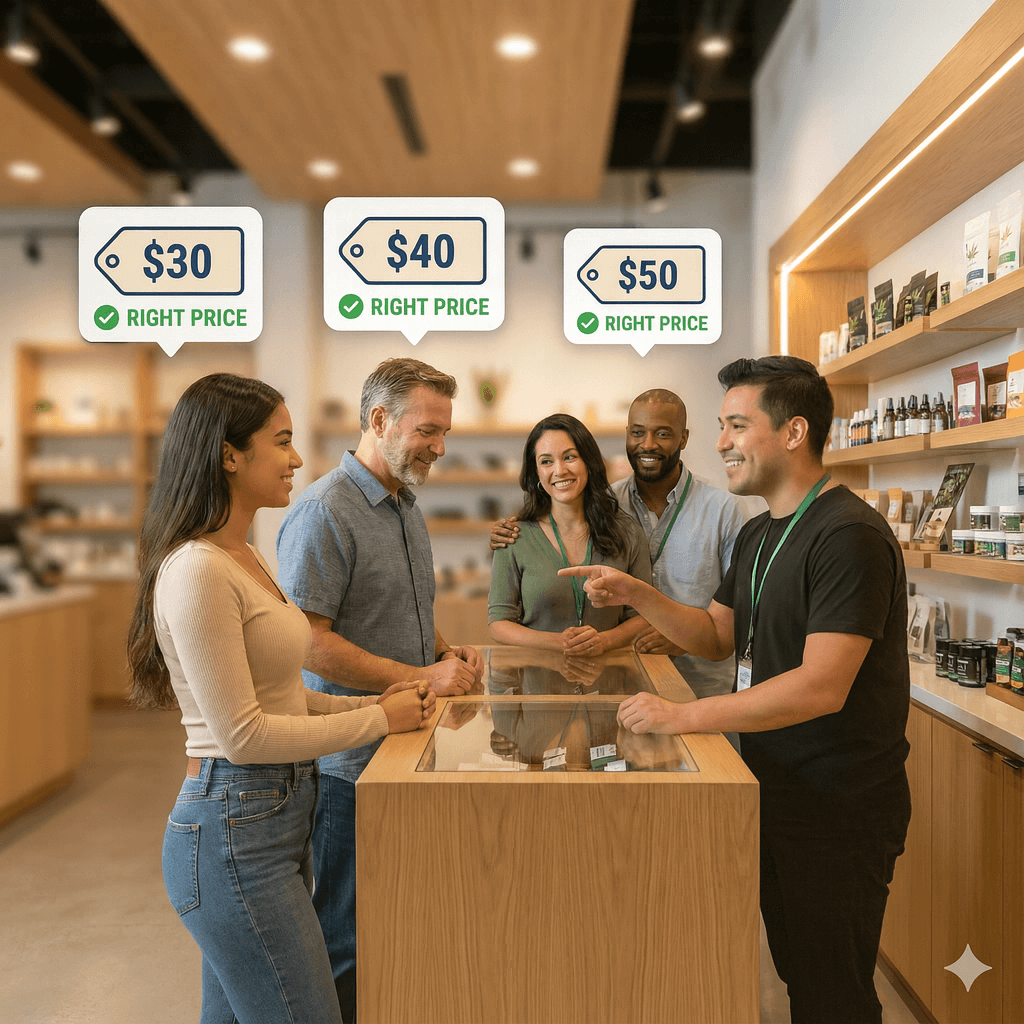
Your $35 eighth isn’t expensive. But next to your $25 and your $60 options, it feels expensive.
That’s the problem right there. Your prices aren’t just numbers—they’re telling a story about your shop, your quality, and whether customers can trust you. And most dispensaries are accidentally telling the wrong story.
The truth is, pricing decisions happen in your customer’s head before they ever reach the counter. They’re reading signals, making comparisons, deciding if this feels right. When your pricing structure is clear and honest, people buy faster and come back sooner. When it’s confusing or suspicious, they hesitate—or worse, they leave.
Let’s fix what’s costing you sales.
Why prices shape how customers feel about your shop
People don’t calculate value like spreadsheets. They feel it.
Put a $40 product between a $30 and a $45 option, and suddenly it makes sense. Put that same $40 product between a $25 and a $75 option, and now it looks expensive—even if nothing about the product changed.
That’s anchoring. And it’s working on your customers right now, whether you planned for it or not.
Here’s what else your prices are saying: Are you premium or budget? Consistent or chaotic? Do you know what you’re doing, or are you just guessing?
When customers see three products at $30, $35, and $55 with no clear difference in quality or positioning, they get suspicious. “Why the random jump? What am I missing?” That confusion doesn’t inspire confidence—it inspires leaving.
Good pricing removes questions. Bad pricing creates them.
The three pricing mistakes most shops don’t notice
Mistake one: random gaps that confuse instead of guide.
If you jump from $30 to $55 with nothing in between, you’ve created a canyon.
Customers standing at the edge usually just turn around. Smooth tiers—$30, $40, $50—give people a path to walk. Random gaps make them wonder what you’re hiding.
Mistake two: no clear “this one” option.
When everything looks equally valid, nothing looks right. Your best-seller—the one most people should pick—needs to be obvious. Not buried. Not requiring explanation. Just clearly the right middle choice that makes sense to most buyers.
Mistake three: prices that argue with quality.
Charge $50 for something that hits like $30, and your customers will remember—just not in the way you want. Overpricing mediocre product doesn’t make it premium. It makes you look dishonest. And honesty is the only thing keeping customers loyal in a market this crowded.
Make choosing easier, not harder
The goal isn’t to trick people into spending more. It’s to help them decide faster.
Three tiers. That’s it. Good, better, best.
Your “good” tier serves the budget-conscious. Your “best” serves the connoisseurs who know what they want. But your “better” tier—that’s where most sales should happen. Price it fairly, position it clearly, make it the path of least resistance.
When someone walks in (or scrolls your menu) and immediately knows which option makes sense for them, that’s not manipulation. That’s respect for their time and their money.
Your budtenders already do this instinctively. They guide people toward the right fit based on what they hear in the first thirty seconds of conversation. Your pricing should do the same thing before the conversation even starts.
When less discounting makes you more money
Discounts feel like generosity. But they teach customers to wait.
Run a 20% sale every other week, and people learn your “regular” prices don’t mean anything. They’ll delay purchases, stockpile during sales, and disappear when prices normalize. You’re not building loyalty—you’re training bargain hunters.
The shops that build real customer relationships? They price honestly from the start and hold steady. Customers learn to trust that your prices reflect actual value, not artificial inflation waiting for the next promotion.
Yeah, run a sale when it serves a purpose—clearing old stock, celebrating a milestone, thanking regulars during a slow week. But if your entire pricing strategy is “discount until it moves,” you’re just teaching people you don’t believe in your own prices.
Stability builds trust. Trust builds habits. Habits build revenue that lasts.
Watch what happens
You don’t need complex analytics. Just pay attention.
After adjusting a price, watch movement. Did more people pick the $38 option after you dropped it from $42? Did your top-shelf sit longer after the increase? Are customers asking more questions about a product that used to sell itself?
The feedback is immediate if you’re looking for it. Track it simply—what’s moving, what’s stalling, what changed. Then adjust again if needed.
Pricing isn’t permanent. It’s a conversation with your market, and they’re telling you every day what resonates and what doesn’t.
The shops that win on pricing aren’t trying to maximize every dollar on every sale. They’re trying to make every decision feel easy and fair. Clear tiers. Honest value. Steady prices that match quality.
Do that, and your customers won’t just buy more—they’ll trust you more. And trust is what brings them back when ten other shops are offering the same flower at similar prices.

Leave a Reply