
Reefer, Racism, and Rebranding: The Real Story of Marijuana
You’ve probably heard some version of this story.
That “marijuana” was a racist term. That it was propaganda. That some guy named Harry Anslinger—who you’ve maybe never heard of—used it to demonize Black and Latino communities in the 1930s.
Cool. That’s the elevator pitch.
Now let me show you the actual receipts. Because the real story is worse than the legend—and it’s still costing your business money today.
“Marijuana” wasn’t slang—it was a weapon
Let’s start with what most people get wrong.
Some historians will tell you “marijuana” wasn’t invented by racists. That it was already floating around in newspapers before Anslinger got his hands on it. That it showed up in the 1890s, maybe earlier in Mexican papers. That it was just… a word.
And technically? They’re right.
But here’s what they leave out: why Anslinger chose that word over every other option.
In 1937, when he testified before the Senate to push the Marihuana Tax Act, cannabis had been in the U.S. Pharmacopoeia since 1850. Doctors called it cannabis. Pharmacists called it cannabis. It was a known medicine with a known name.
Anslinger didn’t use that name.
He also didn’t use “hashish”—which was more common in U.S. newspapers at the time.
He used marihuana. The Spanish word. The one that sounded Mexican.
And when he showed up to Congress, he brought a letter from a Colorado newspaper editor. Let me quote it for you:
“I wish I could show you what a small marihuana cigaret can do to one of our degenerate Spanish-speaking residents.”
That wasn’t a random example. That was the entire strategy.
Anslinger didn’t invent the word “marijuana.” He weaponized it. And then he put it in federal law.
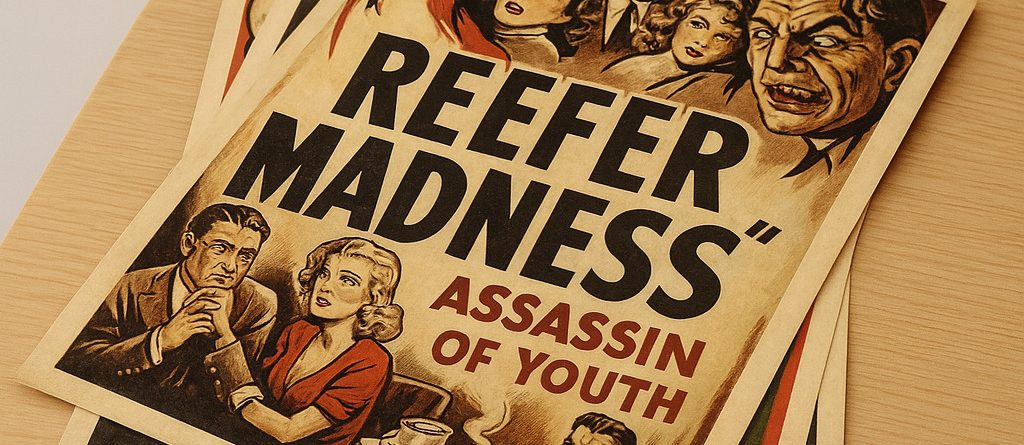
The propaganda machine that made “reefer madness” real
Here’s where it gets darker.
Anslinger wasn’t subtle about what he was doing. He said the quiet part out loud—over and over again.
He claimed cannabis made Black and Latino people “forget their place in the fabric of American society.”
He built “gore files”—fabricated horror stories about families murdered by “youthful addicts” high on reefer. Whole families, he’d say, slaughtered in their homes by kids who smoked a joint.
He co-wrote magazine articles with titles like “Marihuana: Assassin of Youth.”
And newspapers ate it up. Sensational headlines. Moral panic. Reefer Madness wasn’t satire back then—it was a warning, as far as white America was concerned.
The playbook was simple: tie the plant to Mexicans and Black jazz musicians. Make it sound foreign. Make it sound dangerous. Make white people scared.
The result? Congress passed the Marihuana Tax Act in 1937. And that term—marihuana, not cannabis—got codified into federal law.
So yeah, the word existed before Anslinger. But he’s the one who turned it into a weapon. And the weapon worked.
The harm isn’t historical—it’s happening today
Now here’s the part where someone always pushes back.
“Okay, yeah, that’s messed up. But it’s 2025. Language evolves. Nobody thinks ‘marijuana’ is racist anymore. It just means weed.”
I get it. And if we were just talking about etymology, maybe you’d have a point.
But we’re not talking about words in a vacuum. We’re talking about what those words do.
The “language evolves” defense is actually the proof. Marijuana evolved from medical term → propaganda slang → legal statute → cultural norm. That’s not evolution—that’s exactly how propaganda works. It doesn’t feel like propaganda once it’s normalized. That was the design.
So let me show you what “marijuana” is still doing.
Right now—today, in 2025—Black Americans are arrested for cannabis possession at a rate 3.6 to 3.73 times higher than white Americans. That’s despite identical usage rates across racial demographics.
Want to know what’s wild? 88 to 92 percent of those arrests are for simple possession. Not dealing. Not trafficking. Not running a grow operation. Just having it.
And cannabis arrests make up half of all drug arrests in this country.
Half.
Here’s the kicker: studies show that when states legalize, the disparity drops immediately. Great, right? Progress.
Except then it creeps back up.
Chicago. Indianapolis. The data’s there. Legalization helps. But the structural bias—the targeting, the enforcement patterns, the muscle memory built during 90 years of the “marijuana” drug war—it reasserts itself.
Legalization without linguistic correction perpetuates harm. States can legalize cannabis while still using federal “marijuana” terminology in enforcement databases, which maintains the racialized target in practice even when law changes in theory.
Because the term isn’t neutral. It never was. And the system that got built around that term? It’s still running.
State governments are already making the switch (and saying it out loud)
Now let me show you something that should make you sit up.
You know what New York State wrote into its Cannabis Law when it legalized? Let me quote it:
“Marijuana is a term that grew in popularity in the late 19th century to refer to cannabis and was historically used in a derogatory way towards certain ethnic groups.”
That’s not an activist blog. That’s not some think tank white paper.
That’s state statute.
Washington did the same thing in 2022. Removed “marijuana” from law entirely. Cited the racist origins.
The National Hispanic Caucus of State Legislators passed a resolution urging states to drop the term because it perpetuates “racial prejudice.”
NY and WA aren’t just changing words—they’re using statutory language to formally acknowledge harm. When governments explicitly call out “marijuana” as derogatory in law, that’s not political correctness. That’s policy correction.
So if state legislatures are now formally repudiating the word in law—calling it out by name as derogatory—what does it say if your dispensary menu still uses it?
The business case: federal “marijuana” definitions are costing the industry billions
And before you write this off as performative language policing, let me give you the business case.
Because this isn’t just about doing the right thing. It’s about the fact that the federal government’s continued use of “marijuana” is creating regulatory chaos that’s costing the industry billions.
Right now, federal law still uses “marijuana.” State law uses “cannabis.” That’s not just a semantic disagreement. It’s a legal nightmare.
The 2018 Farm Bill legalized hemp. Great. Except now the feds are trying to reclassify hemp-derived THC products—delta-8, delta-9 derivatives, all the stuff flying off shelves—as “marijuana” under the old definitions.
You know what that industry is worth? $11 billion this year. Projected to hit $47 billion by 2032.
And it’s all at risk because federal law is still using a term from a 1937 propaganda campaign.
Every compliance headache you deal with. Every banking restriction. Every time you have to explain to a vendor or investor why your product is legal in your state but illegal federally—that’s the legacy of “marijuana.”
The instability isn’t theoretical. It’s costing you money right now.
How to make the switch (it’s easier than fixing your GBP)
So what do you do about it?
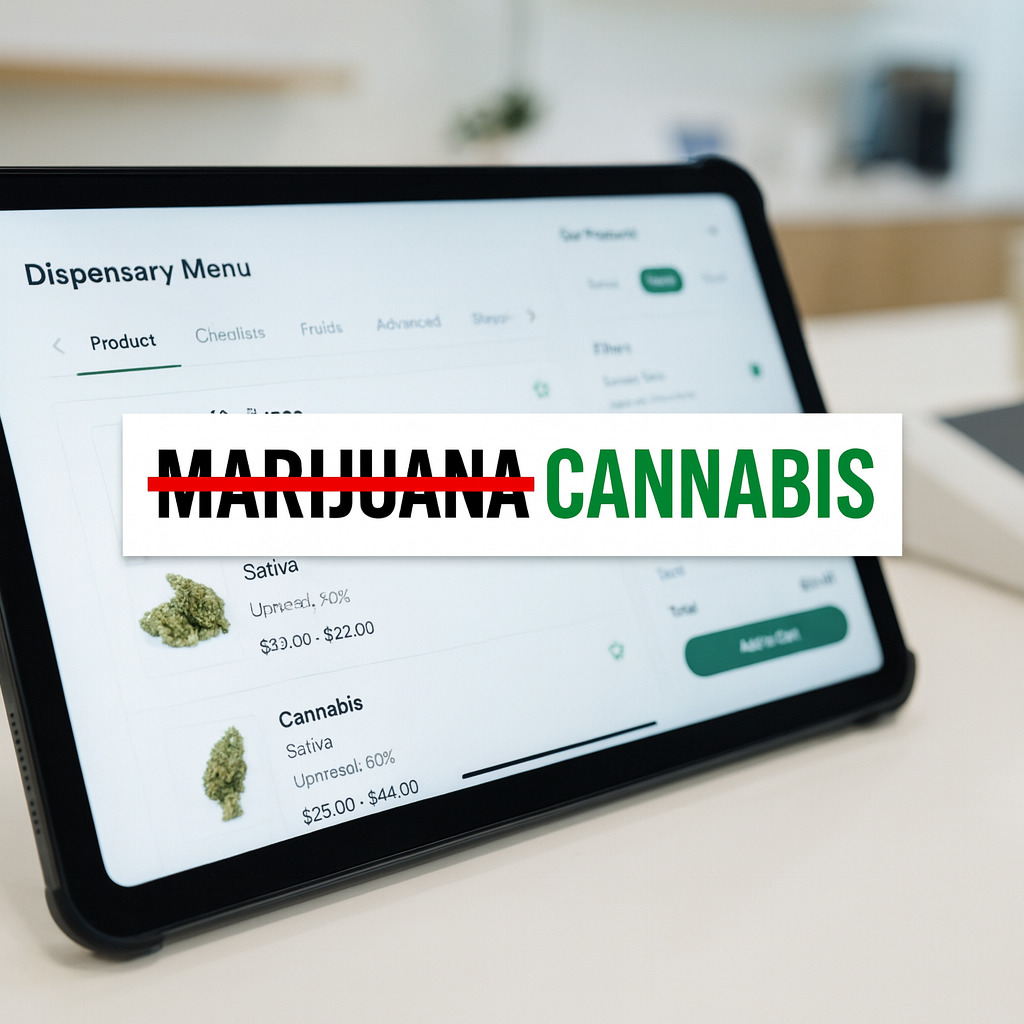
Cannabis is the plant’s actual name. “Marijuana” is the name racists gave it to scare people. That’s not opinion—that’s documented history. So why keep using the propaganda term?
Making the switch is easier than you think.
Audit your menu. Your website. Your signage. Your social media. Your staff scripts. Everywhere you say “marijuana,” change it to “cannabis.”
If your brand voice is irreverent and you want to say “weed,” fine. It’s reclaimed. It’s not carrying the same baggage. But “marijuana”? Retire it. Save it for when you’re talking about history or quoting federal law.
Update your team with one sentence: “We use ‘cannabis’ because it’s the plant’s real name. ‘Marijuana’ was created to criminalize communities of color. We’re done with it.”
If a customer asks, you say: “Cannabis is the scientific term. Marijuana was propaganda. We’re choosing accuracy.”
That’s it. You don’t need to make a big announcement. Just do it. Most customers won’t even notice. The ones who do will respect it.
This isn’t virtue signaling—it’s knowing your product’s history
But here’s the question that should bother you: If “marijuana” is “just a word” that doesn’t matter anymore, why does federal law still use it? And why are Black Americans still arrested 3.6x more often under that term? The “it’s just a word” defense only works if you ignore the data.
And if you’re thinking, “This feels like performative rebranding”—fair. But Aunt Jemima rebranded. The Washington Redskins changed their name. Those weren’t small decisions. They were billion-dollar brands with decades of market recognition choosing to walk away from terms rooted in racial harm.
The difference? You’re not a pancake syrup with 130 years of shelf presence. You’re a dispensary with a Google Business Profile and a menu. Switching from “marijuana” to “cannabis” takes an afternoon, not a rebrand campaign.
And you know what? While writing this, I realized something. I still catch myself looking around before I say “marijuana” out loud. Even when it’s legal. But I don’t do that with “cannabis.” I don’t do that with “CBD.” That hesitation? That’s not paranoia. That’s the propaganda still working. Ninety years later, the word still makes you feel like you’re doing something wrong.
Someone’s paying attention. Maybe it’s the budtender who’s Black and wondered if you knew the history. Maybe it’s the customer who grew up hearing “marijuana” used as a slur against their family. Maybe it’s the city councilmember deciding which dispensaries get renewal priority for social equity alignment. Or maybe it’s just you, six months from now, realizing you kept using a term you knew was rooted in harm because changing it felt like work.
Cannabis survived 90 years of prohibition, propaganda, and enforcement that targeted Black and Brown communities with surgical precision.
Anslinger picked the word “marihuana” because it sounded foreign. He sold it to Congress with racist lies. He put it in federal law to make it stick. And for nearly a century, that term has been doing exactly what it was designed to do—making people think this plant is dangerous, foreign, and connected to the wrong kind of people.
You can keep using it. Plenty of dispensaries do.
Or you can call it what it actually is—cannabis—and stop carrying water for a propaganda campaign that ended careers, destroyed families, and filled prisons.
The story’s ugly. But how does it end?
That’s up to you.

Leave a Reply