
3 Things That Make Customers Trust Your Shop More
Your shop might be great. Your inventory’s dialed. Your budtenders know their stuff. But here’s the part that stings: someone down the street with worse products and worse service is getting the sale.
Not because they’re better. Because they look more trustworthy online.
Trust doesn’t start at the counter anymore. It starts when someone’s scrolling on their couch, trying to decide which dispensary to visit. And if your digital presence feels patchy or out of date, they’re already picking someone else.
Here’s what most owners miss: trust isn’t about marketing budget or fancy websites. It’s about showing up consistently in the right places. And here’s the harder truth—once someone else establishes trust dominance in your local search, they don’t just get more customers. They get most of them. Second place doesn’t split the market. Second place gets leftovers.
Three simple signals can shift how people see your shop before they ever walk through the door.
Trust starts before customers walk in
Think about the last time you tried a new restaurant. You didn’t just show up.
You checked the reviews. Looked at photos. Made sure the hours matched. You wanted proof it was worth the drive.
Your customers do the same thing. They’re Googling your shop at 9 PM, comparing menus, trying to figure out if you’re legit. That search is the first impression—and if what they find feels sloppy or incomplete, they bounce.
Here’s the reality: customers can’t taste, smell, or test cannabis before buying—unlike almost any other retail product. Trust signals are the market’s solution to that gap. When there’s no way to verify quality beforehand, people look for proxies: consistency, social proof, signs that you’re still paying attention.
And here’s what changes the math: trust doesn’t just affect if someone visits. It affects how much they spend once they’re there. A customer who trusts you before walking in buys more confidently. They ask fewer questions. They’re already halfway sold.
Digital trust works 24/7 for every searcher. Physical trust lives in one person’s memory. Yet most dispensaries still treat their Google profile like a forgotten sign.
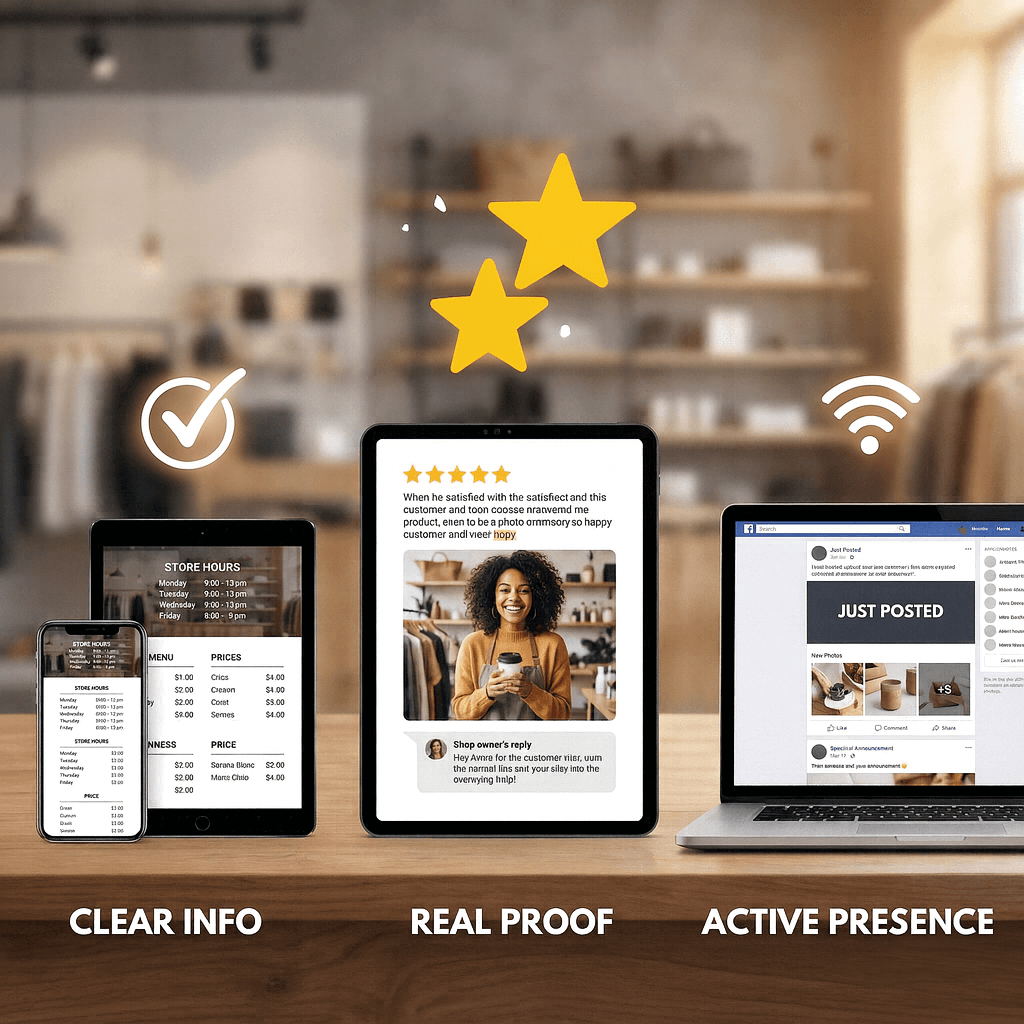
Signal 1 — Clear, accurate info everywhere
Your hours say 9 AM on Google. Your website says 10 AM. Your menu on Weedmaps has different prices than your POS.
Small mismatches like that feel harmless to you—but to a customer who’s never been to your shop, they’re red flags. If you can’t get your hours right, what else is wrong?
Here’s the thing: consistency is expensive to maintain—which is exactly why it’s credible. Low-quality operators can’t sustain weekly updates, thoughtful review responses, and accurate info everywhere. That effort is what makes it a trust signal.
When your info matches across Google, your website, and any listing platform, people stop second-guessing. They stop wondering if you’re actually open. They stop worrying the menu they’re looking at is outdated.
Fix this once and it pays off every day. Go through Google Business Profile, your site, Weedmaps, Leafly—wherever you show up—and make sure hours, location, menu, and pricing all align. If something changes, update it everywhere at once.
Consistency isn’t extra credit. It’s the baseline.
Signal 2 — Real customer proof
Reviews aren’t just vanity metrics. They’re the closest thing to word-of-mouth online. And how you handle them matters more than you think.
Here’s what Google actually weighs now: review velocity matters more than review volume. A shop with 50 reviews in the last 3 months outranks one with 500 reviews spread over 3 years. Steady flow signals current relevance. A big pile of old reviews? That reads as dormant.
And here’s something most owners get wrong: negative reviews without responses hurt you. Negative reviews with thoughtful responses can actually build trust—they show accountability. Don’t fear the bad review. Fear ignoring it.
Respond to reviews. Not every single one, but enough that people see you’re paying attention. Thank someone for a kind word. Address a complaint calmly and professionally. It shows you care about what happens after the sale.
Here’s the interesting part: shops that started responding to all reviews—even the positive ones—saw review velocity increase 30-40%. Responses don’t just address past customers. They encourage future ones to leave reviews too.
And photos? Even better. User-generated content—customers posting pics of their haul, your space, your vibe—outperforms professional business photos in both algorithm weight and conversion. It’s perceived as more authentic. It signals active patronage, not just a one-time photoshoot from two years ago.
Shops with customer-uploaded photos in the last 30 days convert 2-3x better than shops with only business-uploaded photos from 6+ months ago. That gap is real money.
Signal 3 — A shop that looks alive online
Here’s the shift that matters: Google now weights freshness and engagement over static optimization. You can have perfect SEO, perfect business info, every technical box checked—but if your profile’s been dormant for months, you’re getting buried.
Posts, photo uploads, review responses—these signal that a business is actively managed. The algorithm interprets ongoing activity as current relevance.
Dormant profiles get deprioritized even with flawless data.
Active shops attract active customers.
If your last Google post was six months ago and your profile photos still show the old counter setup, people assume you’re coasting. They assume you’re not paying attention. And if you’re not paying attention online, maybe you’re not paying attention in the store either.
You don’t need to post every day. But a weekly update—new products, a simple announcement, a fresh photo—keeps your presence warm. It shows you’re still here. Still engaged. Still worth choosing.
Think of it like this: your online profile is your storefront window. If it’s dusty and unchanged for months, people walk past. If it’s updated and cared for, they stop and look.
Here’s the edge you have: MSOs can’t fake local authenticity at scale. Their corporate social media teams can’t maintain the kind of genuine, responsive presence that single-location operators can. This is your structural advantage—if you’re willing to do the work.
Check your trust signals weekly
Set a calendar reminder. Five minutes. Once a week.
Check that your hours are accurate. Scan your most recent reviews. Upload a new photo if you’ve got one. Update a post if there’s something worth sharing.
Small, consistent actions build trust faster than one big campaign. And unlike ads, trust compounds. Every update stacks on the last one.
Here’s what to remember: trust signals can be established in weeks with consistent action. You’re not competing against decades-old brands with unshakeable reputations. You’re competing against other inconsistent operators in your local market. Most of them aren’t doing this work either.
The restaurant industry learned this lesson between 2010-2015 when Yelp reshaped local search. Early adopters who responded to reviews and maintained fresh photos dominated. Late adopters faced steeper acquisition costs and trust deficits they never closed. Winner-take-most dynamics emerged fast.
Or look at what happened with ghost restaurants during the pandemic.
Delivery-only brands with no physical presence struggled hard with trust. The ones that invested in transparency signals—photos, story, responsiveness—survived. The ones that didn’t disappeared. When customers can’t physically verify quality, trust signals become everything.
You can buy attention. You can’t buy trust. Trust must be demonstrated through consistent behavior over time.
The dispensary that learns faster wins. And right now, that just means showing up online the way you already show up in person.
Leave a Reply